
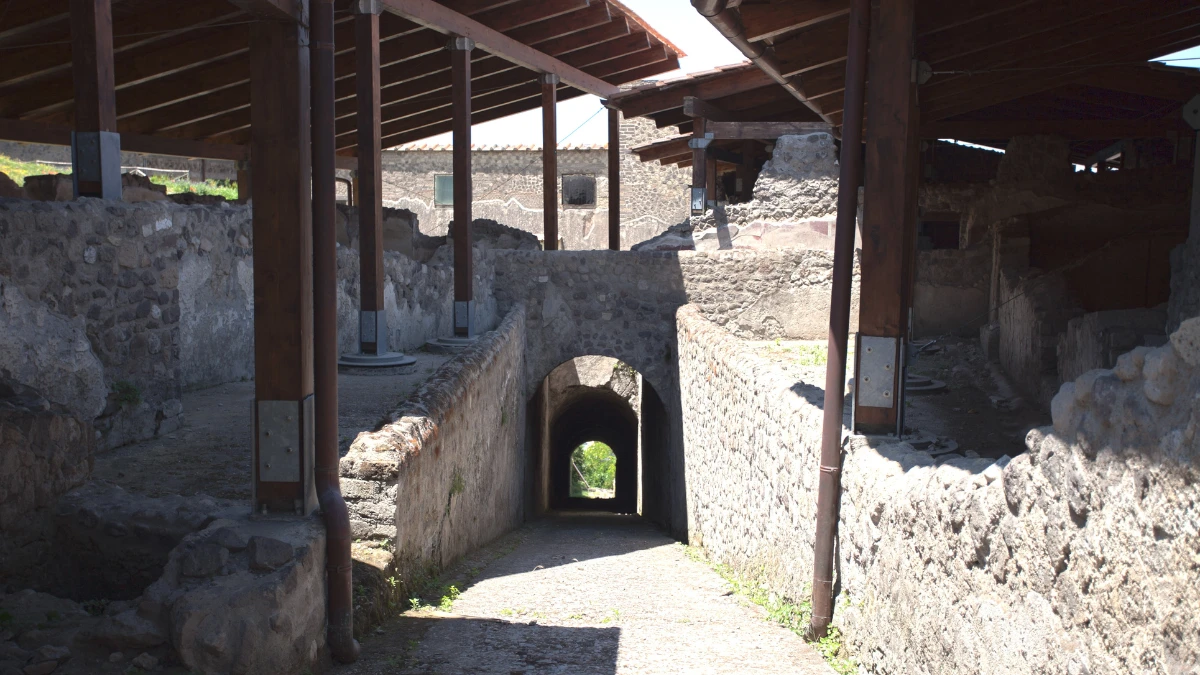
Stabiae is an ancient Roman site in the modern town of Castellammare di Stabia, 5 km south-west of Pompeii. Unlike Pompeii (a city) or Herculaneum (a resort town), Stabiae was a district of aristocratic sea-view villas — large properties used as retreats by Rome’s wealthiest citizens, perched on a hillside overlooking the Bay of Naples. The main sites open to visitors are Villa San Marco and Villa Arianna. Entry is free with a valid Pompeii ticket within 30 days.
Pliny the Elder died at Stabiae. The famous naturalist and admiral — the sole ancient witness who described the 79 AD eruption in detail and whose letters Pliny the Younger addressed to Tacitus are our primary literary source for the disaster — sailed across the Bay of Naples toward Stabiae to rescue a friend, and died there during the second pyroclastic surge. His death site is somewhere in the hillside villas of the modern town of Castellammare di Stabia.Stabiae is one of the least visited sites in the Vesuvian circuit despite having some of the best-preserved villa architecture outside Herculaneum. This is partly due to location (requires a car or dedicated trip) and partly due to profile — the name is less famous than Pompeii or Herculaneum. For visitors with the time and interest, it offers an experience of Roman aristocratic leisure villa culture that neither Pompeii nor Herculaneum can match.
Top Tickets
# Entry Ticket with Audio Guide
# Guided Tour with an Archaeologist
# 2-Hour Small Group Tour
Table of Contents
History of Stabiae
Was Stabiae destroyed by the same eruption as Pompeii? Yes — Stabiae was buried by the eruption of Mount Vesuvius in 79 AD, the same event that destroyed Pompeii and Herculaneum. The volcanic material that covered Stabiae was different from Pompeii’s ash-and-pumice fall — a mix of tephra and reworked deposits that preserved the villas at lower depth. Stabiae was first excavated in the 18th century under the Bourbon kings; excavation continued sporadically until modern times.
Before the eruption, Stabiae was not a city but a district of elite residential villas overlooking the Bay of Naples from the Varano plateau above modern Castellammare di Stabia. The natural setting — elevated, with panoramic sea views and sea breezes — made it ideal for the kind of retreat villa that Rome’s aristocracy built throughout the Bay of Naples coastline. The philosopher Cicero owned a property in the Stabiae area; the bay was dotted with the villas of senators, generals, and emperors.
After the 79 AD eruption, Stabiae was partially rebuilt and occupied in the following centuries. The Bourbon excavations of the 18th century removed a large quantity of finds — frescoes, statues, and objects — to the royal collections at Portici (later transferred to Naples). These 18th-century excavations were poorly documented, and many important pieces are difficult to trace today.
Villa San Marco
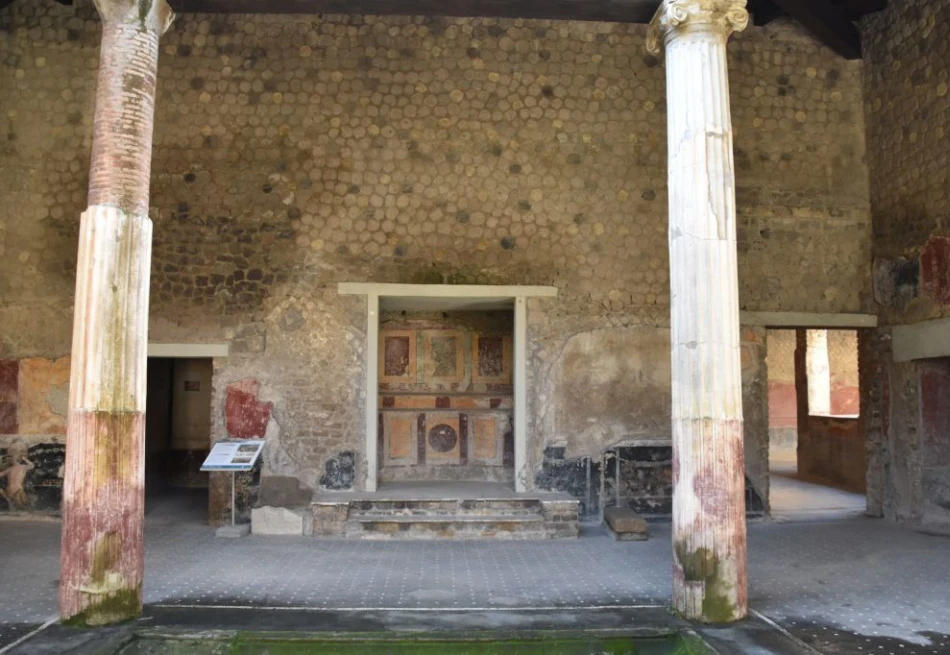
What is Villa San Marco at Stabiae? Villa San Marco is one of the largest and most impressive Roman villas in the Stabiae district — spanning approximately 11,000 square metres across multiple terraces on the hillside. It is named after a nearby chapel. The villa is famous for its large swimming pool (one of the largest private pools from the ancient Roman world), spacious courtyards, elaborate garden terraces, intricate mosaics, and colourful mythological frescoes.
Named after a nearby chapel, Villa San Marco is the showpiece villa of the Stabiae archaeological site — one of the largest private buildings from the ancient Roman world. The property is arranged across multiple terraces descending the hillside, creating a sequence of spaces that were originally organised around spectacular sea views toward Capri and the Gulf of Naples.
What to See
- The Swimming Pool (Natatio): A large rectangular pool in a garden setting — one of the biggest private swimming facilities from antiquity. The surrounding colonnade and garden plantings are partially reconstructed
- The Frescoes: The villa’s walls retain substantial fresco programmes in vivid colours — mythological scenes, architectural illusions, and decorative bands. The quality is comparable to mid-range houses in Pompeii but with a grandeur of spatial setting that Pompeii’s urban plots cannot match
- The Baths: A private bath suite (frigidarium, tepidarium, caldarium) decorated with fine mosaic floors and stucco
- The Triclinium: The dining room with its surviving floor mosaic and painted walls gives a sense of how aristocratic entertaining was staged in a villa of this size
- The Terraced Gardens: The multi-level garden terraces descend the hillside toward the original sea view — now partly obscured by the modern town but still suggestive of the landscape setting
Villa Arianna
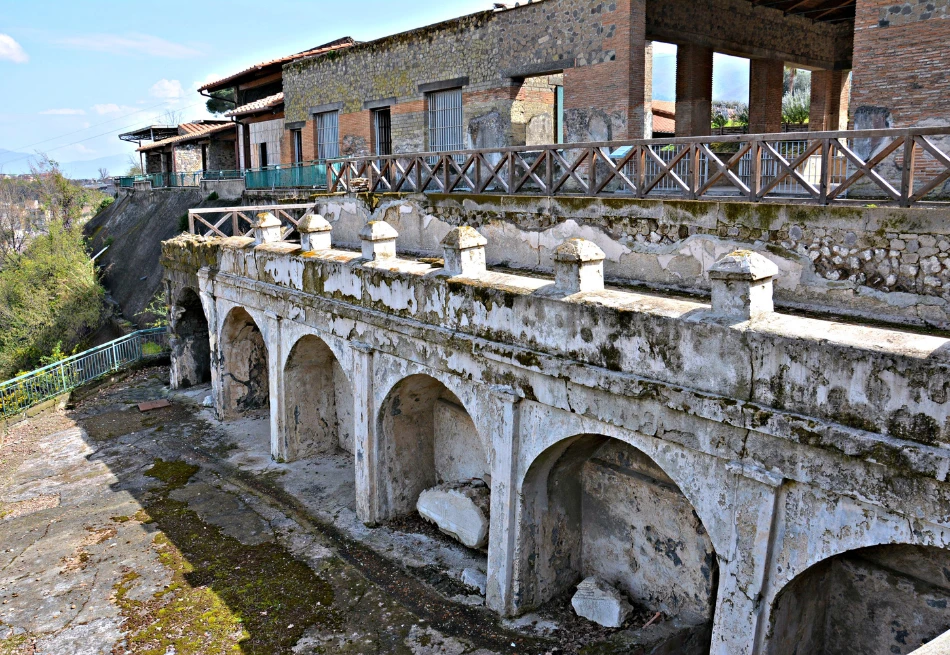
What is Villa Arianna at Stabiae? Villa Arianna is named after its most famous fresco — a large painting of Ariadne, the Greek mythological princess of Crete, being abandoned by Theseus. The villa is slightly smaller than Villa San Marco but has particularly well-preserved fresco cycles and a large open courtyard. It is named in the scholarly literature for the Ariadne painting, which is now in the National Archaeological Museum of Naples.
Smaller than Villa San Marco but more intimate in its fresco quality, Villa Arianna preserves some of the most detailed mythological paintings from the Stabiae excavations. The Ariadne fresco that gives the villa its name — the moment of abandonment on the island of Naxos — is one of the most emotionally compelling paintings from the entire Vesuvian circuit. The original is in Naples; the villa retains other fresco cycles in situ.
What to See
- Fresco cycles: Multiple rooms retain their original fresco decoration — mythological figures, architectural scenes, and decorative borders in the vivid Fourth Pompeian Style
- The Courtyard: A large open peristyle with garden space — the proportions suggest this was the principal outdoor gathering space of the villa
- The Private Baths: A well-preserved bath suite with mosaic floor fragments
- Sea views: From certain terrace areas, the original view toward the Gulf of Naples and Capri is still visible
Villa del Pastore
A third villa — Villa del Pastore — is part of the Stabiae site but receives less attention than Villa San Marco and Villa Arianna. It is notable for its agricultural character: while San Marco and Arianna are aristocratic retreats, Villa del Pastore shows the working farm economy that coexisted with leisure culture in the Stabiae district. Its layout includes living areas, storage rooms, and agricultural processing spaces. Access may be limited depending on ongoing conservation — check pompeiisites.org before visiting.
The Stabiae Museum: Libero D’Orsi Archaeological Museum

The Libero D’Orsi Archaeological Museum (Museo Libero D’Orsi) at Castellammare di Stabia displays finds from the Stabiae excavations — artefacts that remained in the area rather than being transferred to Naples in the 18th century. The collection includes frescoes, mosaics, decorative objects, and documentation of the Bourbon excavations. It provides essential context for the villa sites and is worth visiting alongside them.
Since 2009 the museum has been housed in a restored section of the Quisisana Palace — the former Bourbon royal retreat at Castellammare di Stabia, itself an interesting historical building.
Pliny the Elder and Stabiae
The most famous visitor to Stabiae in antiquity was Pliny the Elder — and he did not survive the experience. On the morning of 25 August 79 AD, Pliny — then in command of the Roman fleet at Misenum — received a request for help from a friend at Stabiae and sailed across the Bay of Naples toward the eruption. He reached the villa of Pomponianus at Stabiae, spent the night, and was found dead on the beach the following morning, apparently killed by the toxic gases and heat of the pyroclastic surges.
His nephew, Pliny the Younger, described the death in a letter to the historian Tacitus — the only direct ancient eyewitness account of the 79 AD eruption to survive. The two letters to Tacitus are the most important literary documents relating to the destruction of Pompeii and the single most important primary source for the eruption’s sequence of events.
Wondering how to reach Pompeii from different locations? Whether you’re coming from Rome, Naples, Amalfi, Sorrento, or Positano, we’ve gathered the best travel options to make your journey easy and hassle-free.
Practical Visitor Information
Tickets & Entry
Is Stabiae free to visit? Entry to Villa San Marco and Villa Arianna is free — there is no entrance fee. However, a valid Pompeii ticket (within 30 days) is required for access as part of the Vesuvian circuit. Some access restrictions apply due to ongoing conservation work.
- Entry: Free — no entry fee for the villa sites
- Pompeii ticket required: Bring your valid Pompeii ticket (within 30 days of issue) for access as part of the circuit
- Temporary closures: Some areas may be closed for excavation or conservation — check pompeiisites.org before visiting
Opening Hours
- Summer (April–October): 9:00 am – 6:00 pm
- Winter (November–March): 9:00 am – 4:00 pm
- Closed: Tuesdays (check for exceptions during peak season)
Getting There
How do you get to Stabiae from Pompeii? Stabiae is 5 km south-west of Pompeii. By train: Trenitalia or Circumvesuviana from Pompei Scavi to Castellammare di Stabia station, then a short taxi ride (approximately 10 minutes) or uphill walk to the Varano plateau where the villas are located. By car: approximately 10–12 minutes from Pompeii via the SS145 road.
- By train + taxi: Train to Castellammare di Stabia station (approximately 15 minutes from Pompei Scavi); short taxi to the Varano plateau
- By car: Via SS145 — approximately 10–12 minutes from Pompeii; parking available near Villa San Marco
- Note: The villas are on the Varano plateau above the modern town — the climb on foot from the station is significant; taxi is recommended
How Long to Allow
Allow 2–3 hours for Villa San Marco and Villa Arianna together. Add 45 minutes if visiting the Libero D’Orsi Museum.
Combining Stabiae with Other Sites
Stabiae works well as an afternoon addition to a morning at Pompeii (same day, if you have energy) or as part of a dedicated 2-day exploration of the Vesuvian circuit. See our 2-day Pompeii itinerary for how to include it.
Note: Though there are many sites to see at Stabiae, you cannot temporarily visit those sites due to the excavation and conservation process. Nevertheless, Villa San Marco and Villa Arianna remain open throughout the years.
Frequently Asked Questions
Are Villa San Marco and Villa Arianna always open?
Both villas are generally open daily, but periodic closures for conservation occur. Villa del Pastore may have more restricted access. Always check pompeiisites.org for current status before making a special trip.
Can you photograph at Stabiae?
Personal photography is permitted throughout the site. Professional photography and video production require advance authorisation from the Archaeological Park of Pompeii.
What makes Stabiae different from Pompeii?
Pompeii was a functioning commercial city. Stabiae was exclusively aristocratic leisure villas — no forum, no commercial district, no crowded streets. The villas are larger, more spacious, and set in landscape rather than urban context. The result is a completely different sense of Roman life: the private, retreating, contemplative side rather than the bustling commercial public world. For visitors interested in how Rome’s elite actually lived (as opposed to how the middle class and tradespeople lived), Stabiae is the more relevant site.
