
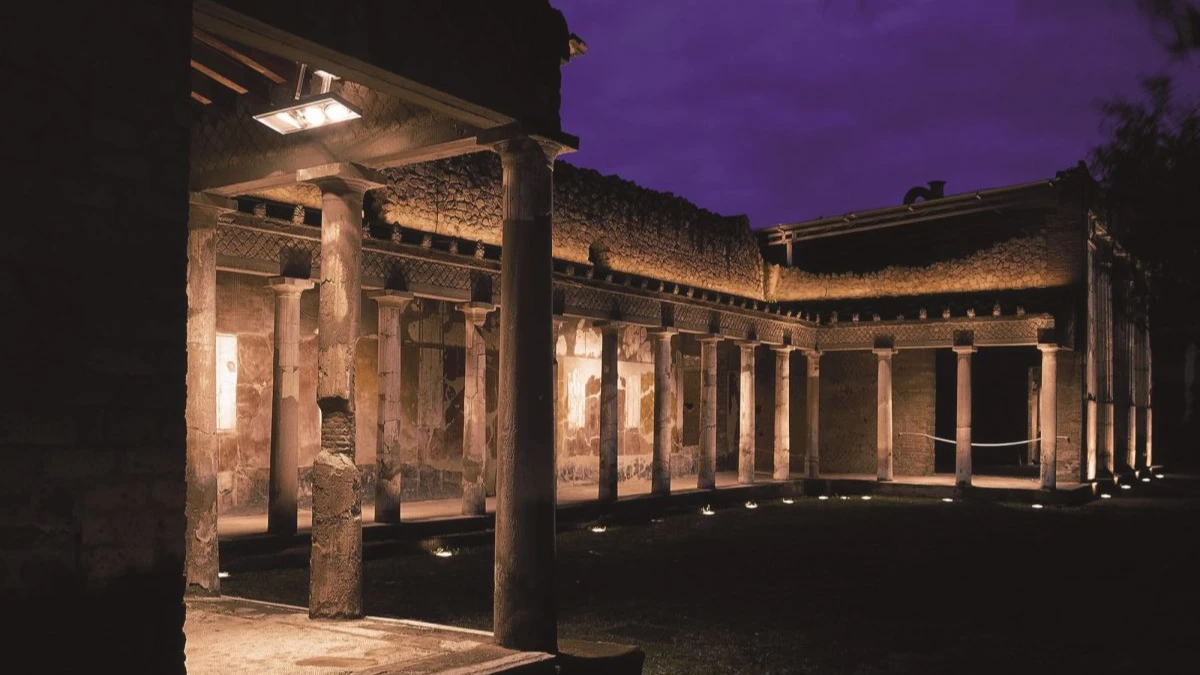
Oplontis is an ancient Vesuvian site located in the modern town of Torre Annunziata, 4 km west of Pompeii. It contains one of the most spectacular surviving Roman villa complexes in the world — the Villa of Poppaea (Villa A), attributed to Emperor Nero’s wife Poppaea Sabina. The villa is famous for its extraordinary Second Style frescoes, large swimming pool, and extensive garden. Entry is free with a valid Pompeii ticket within 30 days of issue.
Most visitors to the Bay of Naples never find Oplontis. They spend their time at Pompeii, perhaps Herculaneum, and head home without knowing that one of the most breathtaking Roman villa complexes in existence sits quietly in a modern town just 4 km along the coast. The Villa of Poppaea at Oplontis — thought to have belonged to Nero’s famously beautiful second wife — contains wall paintings of an ambition and quality that rival anything at Pompeii, in a building of extraordinary spatial grandeur. Entry is free with a valid Pompeii ticket. Almost nobody goes. This guide tells you everything you need.
Top Tickets
# Entry Ticket with Audio Guide
# Guided Tour with an Archaeologist
# 2-Hour Small Group Tour
Table of Contents
History
Who owned the Villa of Poppaea at Oplontis? The villa is widely attributed to Poppaea Sabina, Emperor Nero’s second wife, based on a ceramic stamp bearing the name ‘Secundio Poppaeae’ found during excavations. Poppaea was born near Pompeii and was one of the most powerful women in the Roman Empire. Whether she owned the villa outright or whether it belonged to members of her family’s freedmen network remains debated by scholars. The eruption of 79 AD buried the villa under volcanic debris; it was rediscovered in the 18th century and systematically excavated from the 1960s onward.
Oplontis was part of the network of coastal villas and estates that lined the Bay of Naples during the Roman period — a shoreline described by ancient writers as so densely built with aristocratic residences that it resembled a single continuous city. Unlike Pompeii (a commercial city) or Herculaneum (a coastal resort town), Oplontis was purely residential — a retreat for the Roman elite, not a functioning urban settlement.
The site comprises two separate structures: Villa A (the Villa of Poppaea — the main attraction, open to visitors) and Villa B of L. Crassius Tertius — a commercial warehouse that has yielded extraordinary finds but is currently closed to the public. The Great Pompeii Project has ongoing conservation and excavation work at both villas.
Villa A: Villa of Poppaea
The Frescoes
The Villa of Poppaea’s walls are covered in Second Style frescoes — the most ambitious type of Roman wall painting, in which artists created the illusion of an open architectural space beyond the wall: columns, porticoes, gardens, and theatrical stage buildings rendered in extraordinary perspective. The effect is of looking through the walls into an impossibly grand exterior. The colours — deep yellow ochre, Pompeian red, Egyptian blue — have survived almost perfectly under the volcanic debris.
The frescoes are among the finest examples of Second Style painting anywhere in the Roman world. Several rooms have paintings of a quality that surpasses comparable work at Pompeii. The large triclinium (dining room) and the cubiculum (bedroom) frescoes are particularly outstanding.
The Architecture
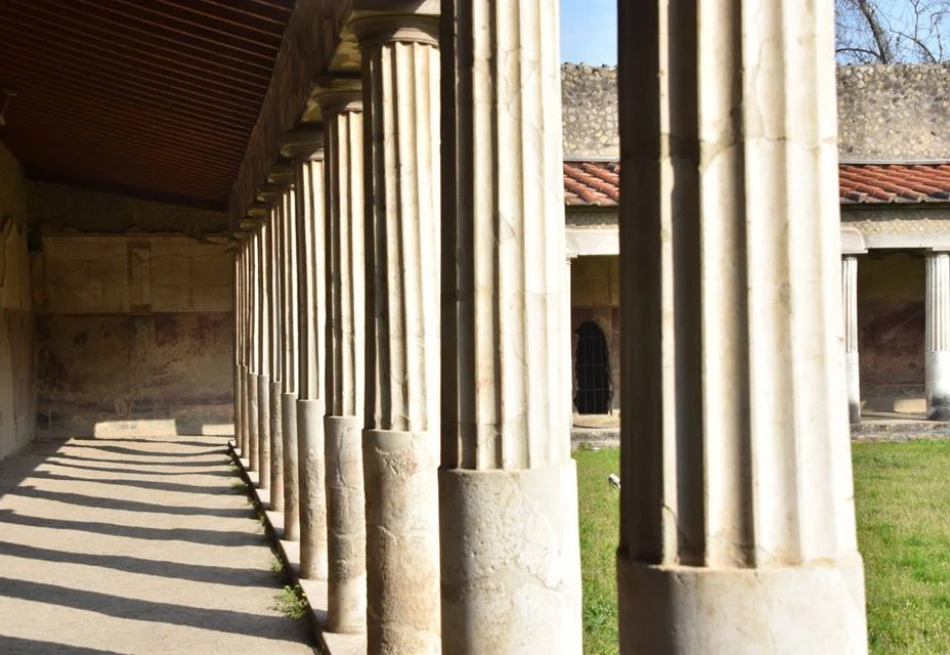
The villa is enormous — over 7,000 square metres — and organised around a long central axis from the entrance to the garden. The spaces include a large atrium with impluvium, multiple reception rooms, a private bath suite (frigidarium, tepidarium, caldarium), dining rooms of several sizes, a colonnade garden, and a large natatio (swimming pool — approximately 61 metres long, one of the largest private pools from the ancient world). The pool’s original planting scheme, with trees positioned for both shade and aesthetics, is partially visible from the excavation evidence.
The Garden
The villa’s garden is one of the best-documented ancient gardens in Italy. Archaeobotanical analysis of root cavities in the soil has allowed partial reconstruction of the original planting — including the positions of large trees that would have provided a dramatic canopy over the pool area. This kind of environmental archaeology gives Oplontis a level of landscape detail unavailable at most ancient sites.
The Finds
During the 79 AD eruption, approximately 54 people were found sheltering in one room of the villa — presumably servants or local refugees who fled there hoping to survive. Their skeletal remains, along with extraordinary quantities of jewellery, coins, and luxury objects left by the fleeing owners, were found on site. Several of these finds — including a superb gold snake bracelet — are now displayed at the National Archaeological Museum of Naples.
Villa B: The Warehouse of L. Crassius Tertius

Villa B is a large commercial warehouse rather than a residence — used for the storage and distribution of agricultural products (probably wine and oil) produced on the surrounding estates. It has yielded a remarkable assemblage of storage vessels, commercial equipment, and the Oplontis Treasure — a collection of gold and silver objects of exceptional quality found in 1974, now in the National Archaeological Museum of Naples. Villa B is currently closed to the public but conservation work is ongoing under the Great Pompeii Project.
Practical Visitor Information
Tickets & Entry
Is Oplontis free to visit? Yes — entry to Oplontis is free with a valid Pompeii ticket within 30 days of issue (full price ticket, not the free Sunday ticket). A standalone entry ticket for Oplontis is also available at the site. The Pompeii Plus ticket (which includes Boscoreale) also covers Oplontis as part of the wider archaeological circuit.
- Free with: Valid Pompeii ticket (Express or Plus) within 30 days of issue — bring the original ticket or a printed/digital copy
- Standalone entry: Small fee payable at the site ticket office
- Guided tour add-on: A small-group guided tour of Oplontis is available locally — ask at the ticket office on arrival
Opening Hours
- Summer (April–October): 9:00 am – 7:00 pm (last entry 5:30 pm)
- Winter (November–March): 9:00 am – 5:00 pm (last entry 3:30 pm)
- Closed: 25 December and 1 January
- Note: The site may have periodic closures for conservation — check pompeiisites.org before visiting
Wondering how to reach Pompeii from different locations? Whether you’re coming from Rome, Naples, Amalfi, Sorrento, or Positano, we’ve gathered the best travel options to make your journey easy and hassle-free.
How to Get There
How do you get to Oplontis from Pompeii? Take the Circumvesuviana train from Pompei Scavi – Villa dei Misteri toward Naples. Alight at Torre Annunziata – Oplonti station — approximately 10 minutes. From the station, Oplontis is a 5-minute walk following the signs. By car from Pompeii: approximately 8 minutes via the SS18 road. Parking is available near the site.
- By train: Circumvesuviana from Pompei Scavi → Torre Annunziata – Oplonti station (10 min); 5-minute walk to site
- By car: Via SS18 from Pompeii — approximately 8 minutes; parking available near the entrance
- By bus: SITA buses connect Torre Annunziata to Pompeii — check local schedules
How Long to Allow
Allow 1.5–2 hours for the Villa of Poppaea. The scale of the villa is larger than most visitors expect — the swimming pool alone is 61 metres long. A relaxed visit covers the frescoed rooms, the bath suite, the garden terraces, and the pool area comfortably in 90 minutes.
Combining with Other Sites
Oplontis pairs naturally with Pompeii (10 min by train) or Herculaneum (15 min by train via Torre Annunziata). The combined Pompeii + Oplontis + Herculaneum circuit is an excellent 2-day itinerary — see our 2-day itinerary guide and Pompeii vs Herculaneum comparison.
Frequently Asked Questions
Is Oplontis better or worse than Pompeii?
Different, not better or worse. Pompeii gives you a complete ancient city. Oplontis gives you one extraordinary building at a depth of detail — particularly the frescoes — that no individual house at Pompeii matches. Serious visitors to the region should see both.
Is Oplontis suitable for children?
Yes — the vast scale of the villa, the swimming pool, and the vivid frescoes make it engaging for older children. The site is quieter and less crowded than Pompeii, which can make for a more relaxed family visit.
Is there parking at Oplontis?
Yes — there is paid parking near the site entrance in Torre Annunziata. The train is a more convenient option if you are based in Pompeii, Herculaneum, Naples, or Sorrento.
